
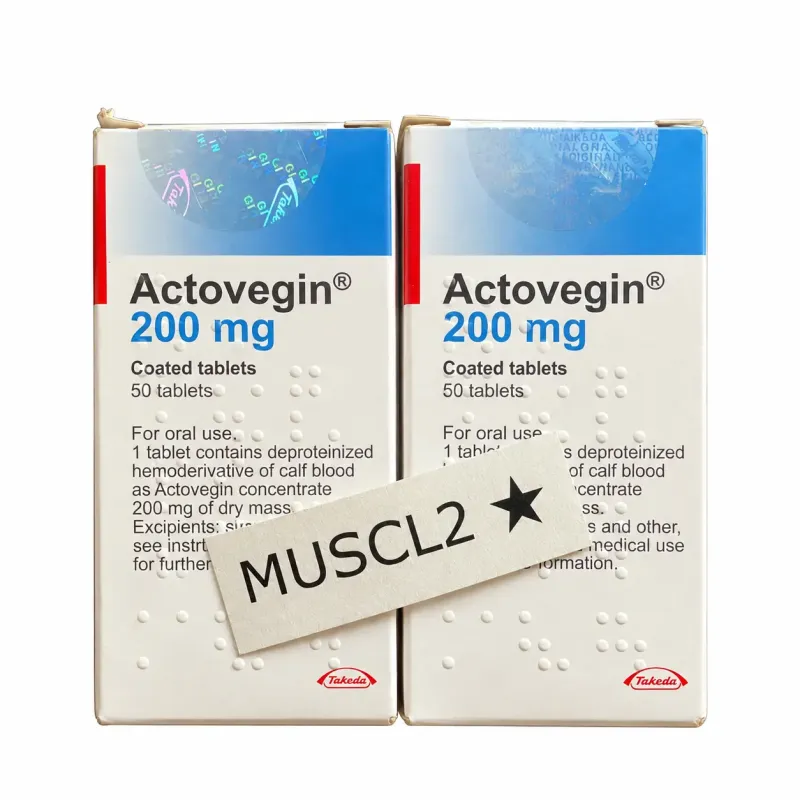
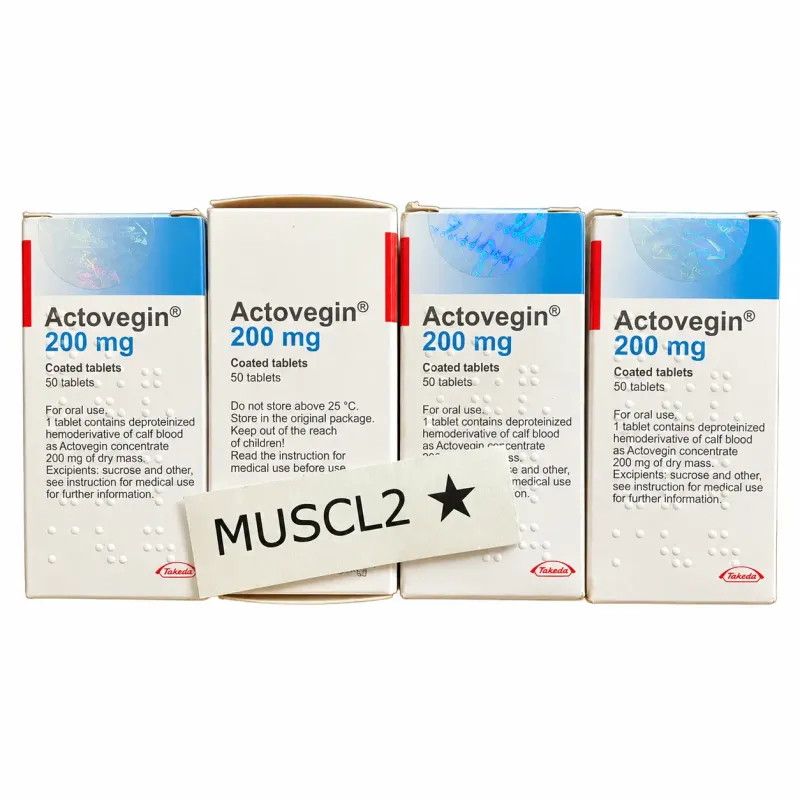
Actovegin 200 mg. (50 tablets)
- Manufacturer: Takeda (Japan)
- Product Code: acto-tabs
- Availability: In Stock
66.00€
- Delivery within EU (3-5 days)
Actovegin 200 mg – 50 Coated Tablets
Actovegin 200 mg is an oral medicinal product containing deproteinized hemoderivative of calf blood. Each coated tablet contains 200 mg of the active substance calculated as dry weight. The product is available in bottles containing 50 coated tablets.
The tablet form provides a convenient option for longer-term oral treatment and is used both as supportive therapy and as a continuation of treatment started with injectable Actovegin.
Product Information
What Is Actovegin?
Actovegin is a biological medicinal product produced from calf blood. During manufacturing, proteins are removed to obtain a deproteinized hemoderivative composed of low-molecular-weight physiological substances.
Its pharmacological effects are centered on cellular metabolism. According to the official product information, Actovegin stimulates cellular oxygen uptake and utilization, energy metabolism, and the uptake and utilization of glucose.
These are fundamental processes for tissues with high metabolic demands, particularly the brain and peripheral nervous system.
Official Medical Uses of Actovegin Tablets
According to the Austrian Summary of Product Characteristics, Actovegin 200 mg coated tablets are used in adults for:
- Supportive treatment of symptoms of dementia
- Continuation of parenteral treatment for symptoms of dementia
- Continuation of parenteral treatment for symptoms of diabetic polyneuropathy
The oral formulation is therefore particularly useful when treatment is intended to continue after an initial course of injections or infusions.
Cellular Glucose Metabolism
One of the best-described pharmacological effects of Actovegin concerns glucose utilization.
The official product information describes inositol-phospho-oligosaccharides present in Actovegin as compounds involved in insulin-independent glucose transport pathways. These compounds can stimulate transport mechanisms such as GLUT1 and activate pyruvate dehydrogenase, an important enzyme complex involved in the conversion of glucose into cellular energy.
In practical terms, this means that Actovegin influences not only glucose uptake but also its subsequent use inside the cell.
Oxygen Utilization and Energy Metabolism
Actovegin also affects cellular oxygen metabolism. Pharmacodynamic research has demonstrated changes in cellular energy-related compounds such as ATP, ADP and phosphocreatine.
ATP is the main immediate energy source used by human cells, while phosphocreatine acts as an important energy reserve. These metabolic systems are especially important in tissues that consume large amounts of energy, including neurons and skeletal muscle.
The combination of effects on glucose utilization, oxygen metabolism and energy-related pathways forms the basis of Actovegin's metabolic activity.
Actovegin and Diabetic Polyneuropathy
One of the most substantial clinical studies of Actovegin involved patients with type 2 diabetes and symptomatic diabetic polyneuropathy.
In a multicenter, randomized, double-blind, placebo-controlled trial, 567 patients first received intravenous Actovegin or placebo and then continued treatment orally for 140 days.
The oral treatment phase used Actovegin tablets as part of a total daily dose of 1,800 mg.
Compared with placebo, Actovegin significantly improved the Total Symptom Score, including neuropathic pain, burning, paresthesia and numbness. Improvements were also observed in vibration perception and sensory nerve function.
Treatment of symptomatic polyneuropathy with Actovegin in type 2 diabetic patients – Diabetes Care →
Actovegin and Post-Stroke Cognitive Function
Oral Actovegin has also been studied as part of long-term treatment in patients with cognitive impairment following ischemic stroke.
The ARTEMIDA trial was a multicenter, randomized, double-blind, placebo-controlled study involving 503 patients aged 60 years or older.
Patients initially received intravenous Actovegin and then continued with oral Actovegin at a dose of 1,200 mg per day for the remainder of the six-month treatment period.
At six months, cognitive performance measured with the extended Alzheimer's Disease Assessment Scale cognitive subscale improved significantly more in the Actovegin group than in the placebo group.
Actovegin and Peripheral Circulation
Actovegin has also been investigated in peripheral arterial disease.
In the international multicenter randomized APOLLO study, 366 patients with Fontaine stage IIB peripheral arterial disease received intravenous treatment followed by oral Actovegin or placebo.
Actovegin treatment produced a statistically significant increase in initial claudication distance and absolute walking distance compared with placebo. Improvements in quality-of-life measurements were also reported.
Neuroprotective Mechanisms
The pharmacological profile of Actovegin includes several mechanisms relevant to nervous-system function.
According to the official product information, experimental studies have identified effects involving:
- Glucose transport and utilization
- Cellular oxygen metabolism
- ATP and phosphocreatine-related energy metabolism
- NF-κB signaling pathways
- PARP-related cellular mechanisms
- Processes associated with oxidative and metabolic stress
- Neuronal survival and cellular metabolism
These mechanisms help explain why Actovegin has been studied particularly in disorders involving metabolic stress of neurons and peripheral nerves.
Why the Tablet Form Is Useful
The injectable and oral forms of Actovegin serve somewhat different practical roles.
Parenteral treatment is often used during the initial phase of therapy when higher doses are required. The tablet formulation then allows treatment to continue over a longer period without repeated injections or infusions.
This sequential approach was used in major clinical trials involving diabetic polyneuropathy and post-stroke cognitive impairment.
Actovegin 200 mg Tablet Composition
According to the official Austrian product information, each coated tablet contains:
- 200 mg deproteinized hemoderivative of calf blood, calculated as dry weight
- 52.3 mg sucrose
- Up to 68 mg sodium
- Up to 13 mg potassium
- Phenylalanine
The tablet core also contains povidone K90, microcrystalline cellulose, magnesium stearate and talc.
The coating contains hypromellose phthalate, sucrose, gum arabic, quinoline yellow (E104), povidone K30, macrogol 6000, talc, titanium dioxide and montan glycol wax.
The tablets are round, glossy and greenish-yellow in appearance.
How Actovegin Tablets Are Taken
According to the Austrian prescribing information, the usual adult dose is 1–2 coated tablets three times daily.
The tablets should be swallowed whole with liquid before meals.
The official maximum daily dose is three tablets three times daily. Treatment may continue for up to 26 weeks depending on the clinical indication and medical assessment.
In some conditions, treatment may initially be started with parenteral Actovegin before switching to the tablet form.
Safety Information
Actovegin should not be taken by patients with known hypersensitivity to deproteinized calf-blood hemoderivative or any of the other ingredients.
Rare adverse reactions listed in the official product information include:
- Allergic reactions
- Drug-related fever
- Urticaria
- Flushing
- Anaphylactic reactions
Myalgia has also been reported, with frequency not established.
At higher doses, occasional stomach discomfort may occur.
Important Information About Excipients
Actovegin tablets contain sucrose and should not be used by patients with certain rare hereditary disorders of fructose or galactose metabolism, glucose-galactose malabsorption or sucrase-isomaltase deficiency.
The sodium and potassium content may also be relevant for patients following controlled sodium or potassium diets.
Because the tablets contain phenylalanine, this should be taken into account in patients with phenylketonuria.
Storage
Actovegin tablets should be stored below 25°C and kept in the original packaging to protect the product from light.
The official Austrian presentation uses a brown Type III glass bottle with an aluminium screw cap.
The product is available in packs of 30 and 50 coated tablets. The shelf life is three years, and the contents should be used within 100 days after the bottle is first opened.
Research Summary
Actovegin 200 mg tablets are an oral formulation of deproteinized calf-blood hemoderivative designed for longer-term metabolic and neurological treatment.
The drug influences cellular glucose utilization, oxygen metabolism and energy-related biochemical processes. The oral formulation has been used in major randomized clinical trials involving diabetic polyneuropathy and post-stroke cognitive impairment.
For patients receiving sequential therapy, the tablet form provides a practical way to continue treatment after an initial intravenous course.
Scientific References
- Ziegler D, Movsesyan L, Mankovsky B, Gurieva I, Abylaiuly Z, Strokov I. Treatment of symptomatic polyneuropathy with Actovegin in type 2 diabetic patients. Diabetes Care. 2009;32(8):1479–1484.
PubMed: PMID 19470838 → - Guekht A, Skoog I, Edmundson S, Zakharov V, Korczyn AD. ARTEMIDA Trial: A Randomized Controlled Trial to Assess the Efficacy of Actovegin in Poststroke Cognitive Impairment. Stroke. 2017;48(5):1262–1270.
PubMed: PMID 28432265 → - Efficacy and safety of Actovegin in the treatment of intermittent claudication: results of an international, multicenter, placebo-controlled, randomized, phase IIIb clinical trial (APOLLO).
PubMed: PMID 36264097 →
FAQ
How much active substance is in one Actovegin tablet?
Each coated tablet contains 200 mg of deproteinized calf-blood hemoderivative calculated as dry weight.
How many tablets are in this package?
This presentation contains 50 coated tablets in a brown glass bottle.
What are Actovegin tablets used for?
According to the Austrian prescribing information, the tablets are used in adults for supportive treatment of symptoms of dementia and as continuation therapy following parenteral treatment of dementia symptoms or diabetic polyneuropathy.
Can Actovegin tablets be used after injections?
Yes. Continuation of parenteral Actovegin treatment is one of the official uses of the tablet formulation, and sequential intravenous-to-oral treatment has also been used in major clinical trials.
Does oral Actovegin affect glucose metabolism?
Actovegin influences cellular glucose uptake and utilization and is associated with activation of metabolic pathways involved in cellular energy production.
Has oral Actovegin been studied in clinical trials?
Yes. Oral Actovegin has been used as part of randomized, double-blind, placebo-controlled treatment protocols in diabetic polyneuropathy and post-stroke cognitive impairment.
Is Actovegin a stimulant?
No. Actovegin is a metabolic biological medicinal product rather than a conventional central nervous system stimulant.
Delivery within the EU
We deliver to all countries within the European Union: