
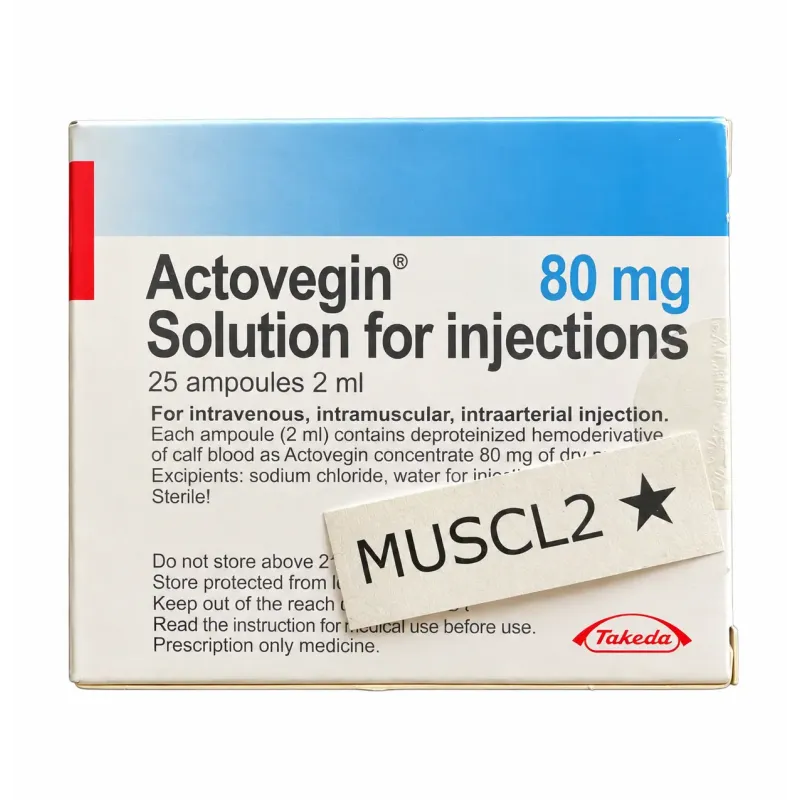
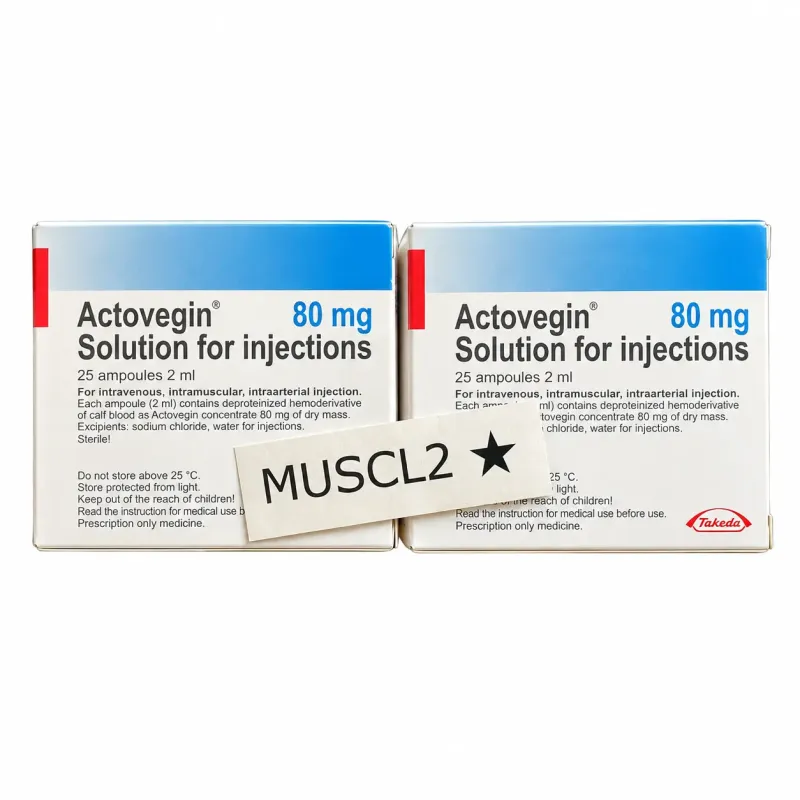
Actovegin 80 mg/ml, 2 ml, (25 ampoules)
- Manufacturer: Takeda (Japan)
- Product Code: acto80
- Availability: In Stock
69.00€
- Delivery within EU (3-5 days)
Actovegin 80 mg / 2 ml – 25 Ampoules
Actovegin 80 mg/2 ml is an injectable medicinal product containing a deproteinized hemoderivative of calf blood. Each 2 ml ampoule contains 80 mg of the active substance calculated as dry weight, corresponding to a concentration of 40 mg/ml.
The 25-ampoule presentation provides a compact 2 ml injectable format of Actovegin. The preparation is used clinically in neurological, metabolic and peripheral vascular conditions and has also attracted interest in sports and exercise physiology because of research into cellular energy metabolism, glucose utilization and mitochondrial function.
Product Information
What Is Actovegin?
Actovegin is a biological medicinal product produced from calf blood using a manufacturing process that removes high-molecular-weight proteins. The resulting deproteinized hemoderivative contains a complex mixture of low-molecular-weight physiological compounds.
Its pharmacological activity is associated with cellular energy metabolism. According to the approved product information, Actovegin increases cellular utilization of oxygen and glucose and stimulates energy-producing metabolic processes, particularly when normal cellular energy metabolism is impaired or when energy requirements are increased.
This metabolic profile explains why Actovegin has been studied in neurological disease, diabetic polyneuropathy, vascular disorders and skeletal muscle metabolism.
Approved Medical Uses
According to the official product information for Actovegin 80 mg/2 ml, the solution for injection is used in the treatment of:
- Cerebral circulatory disorders
- Post-stroke cognitive impairment
- Dementia
- Peripheral arterial circulatory disorders and their consequences
- Peripheral venous circulatory disorders and their consequences
- Arterial angiopathy
- Venous leg ulcers
- Diabetic polyneuropathy
Cellular Energy Metabolism
One of the characteristic pharmacological properties of Actovegin is its effect on cellular energy processes.
When oxygen or metabolic substrates are limited, or when tissues require additional energy for regeneration and repair, Actovegin stimulates processes involved in functional metabolism and cellular anabolism.
Its documented metabolic effects include:
- Increased cellular glucose uptake
- Increased intracellular glucose utilization
- Increased cellular oxygen utilization
- Stimulation of ATP-related energy metabolism
- Support of cellular energy reserves under metabolic stress
- Stimulation of regenerative metabolic processes
ATP – adenosine triphosphate – is the principal immediate source of energy used by cells. For this reason, metabolic pathways affecting glucose oxidation, oxygen utilization and mitochondrial respiration are relevant both in clinical medicine and in exercise physiology.
Mitochondrial Function and Human Skeletal Muscle
One of the most interesting modern areas of Actovegin research concerns skeletal muscle mitochondria.
Researchers at the University of Copenhagen studied permeabilized human skeletal muscle fibers exposed directly to Actovegin. The experiment demonstrated a concentration-dependent increase in mitochondrial oxidative phosphorylation capacity.
Actovegin significantly increased oxidative phosphorylation linked to mitochondrial Complex I. At the higher tested concentration, maximal oxidative phosphorylation involving both Complex I and Complex II was also significantly increased.
The researchers described a marked effect of Actovegin on mitochondrial oxidative function in human skeletal muscle.
Why Actovegin Is Discussed in Sports Pharmacology
Actovegin has been of particular interest in sports medicine because several of the metabolic processes influenced by the drug are also fundamental to muscular work and recovery.
During intensive exercise, skeletal muscle requires rapid ATP turnover, efficient utilization of glucose and oxygen, and high mitochondrial respiratory capacity. These are the same areas in which experimental Actovegin research has demonstrated measurable biological effects.
Areas studied in relation to exercise physiology include:
- Mitochondrial oxidative phosphorylation
- Skeletal muscle mitochondrial respiration
- Glucose metabolism
- Cellular oxygen utilization
- ATP-related energy metabolism
- Exercise-related metabolic stress
- Muscle function and recovery
Actovegin differs from conventional stimulants because its pharmacological interest is centered on cellular metabolism rather than direct stimulation of the central nervous system.
Recent Research: Actovegin and High-Intensity Training
A study published in the European Journal of Applied Physiology in 2026 investigated Actovegin together with high-intensity training and directly measured skeletal muscle mitochondrial respiratory capacity.
Forty healthy male mice were divided into control, Actovegin, high-intensity training and combined Actovegin plus high-intensity training groups.
Actovegin treatment increased Complex I + II-linked mitochondrial respiratory capacity compared with untreated controls. High-intensity training increased exercise capacity, and the improvement in exercise performance was significantly greater in the group receiving both Actovegin and high-intensity training than in the training-only group.
The study provides in-vivo experimental evidence connecting Actovegin administration with skeletal muscle mitochondrial respiration and exercise physiology.
Actovegin and Diabetic Polyneuropathy
Diabetic polyneuropathy is one of the clinically established areas in which Actovegin has been investigated in a large randomized controlled trial.
A multicenter, randomized, double-blind study included 567 patients with type 2 diabetes and symptomatic diabetic polyneuropathy. Patients initially received intravenous Actovegin or placebo, followed by oral treatment.
Actovegin produced statistically significant improvements in neuropathic symptom scores. Sensory nerve function and vibration perception also improved, and a beneficial change was recorded in a quality-of-life parameter.
The investigators concluded that sequential intravenous and oral Actovegin treatment improved neuropathic symptoms, vibration perception, sensory function and quality of life in patients with symptomatic diabetic polyneuropathy.
Actovegin and Cognitive Function After Stroke
Actovegin has also been studied in patients with cognitive impairment following ischemic stroke.
The multicenter, randomized, double-blind, placebo-controlled ARTEMIDA trial included more than 500 patients aged 60 years or older. Treatment started with intravenous Actovegin and was subsequently continued with oral Actovegin.
At six months, patients treated with Actovegin showed a statistically significant improvement in the primary cognitive outcome measured using the extended Alzheimer's Disease Assessment Scale cognitive subscale compared with placebo.
Peripheral Circulation and Tissue Metabolism
The approved indications for Actovegin 80 mg/2 ml also include peripheral arterial and venous circulatory disorders and their consequences.
These include arterial angiopathy and venous leg ulcers. In such conditions, impaired blood supply can reduce the amount of oxygen and metabolic substrates available to tissues.
The metabolic action of Actovegin is directed primarily at cellular utilization of glucose and oxygen. Improvement in tissue blood supply is described in the product information as a secondary effect.
Actovegin 80 mg/2 ml Composition
According to the official product information, each 2 ml ampoule contains:
- 80 mg deproteinized hemoderivative of calf blood, calculated as dry weight
- Water for injection
- Hydrochloric acid solution for adjustment of pH
The active substance naturally contains small quantities of sodium, potassium and phenylalanine.
The solution is clear and yellowish and is supplied in single-use Type I borosilicate glass ampoules with a breaking point.
Route of Administration
Actovegin 80 mg/2 ml solution for injection can be administered intravenously, intramuscularly or intra-arterially. It can also be added to an appropriate infusion solution according to the official product information.
For infusion, the approved product information specifies isotonic sodium chloride solution or 5% glucose solution as compatible base solutions.
When Actovegin is administered intramuscularly, the official product information specifies slow administration and a maximum volume of 5 ml at one injection because the solution is hypertonic.
As with other injectable medicines, administration should be performed according to the prescribing information and under appropriate medical supervision.
Safety Information
Actovegin should not be used in patients with known hypersensitivity to deproteinized calf-blood hemoderivative or another component of the medicine.
General contraindications to infusion therapy listed in the official product information include:
- Congestive heart failure
- Pulmonary edema
- Oliguria
- Anuria
- Hyperhydration
Rare adverse reactions reported with Actovegin include:
- Allergic reactions
- Drug-related fever
- Urticaria
- Skin flushing
- Dizziness
- Severe hypersensitivity reactions including signs of shock
Gastrointestinal discomfort may occur at higher doses.
Storage and Handling
Actovegin ampoules should be kept in their original packaging and protected from light. The product should not be frozen.
Each ampoule is intended for single use. Once opened, the solution should be used immediately. Cloudy solutions or solutions containing visible particles should not be used.
Research Summary
Actovegin 80 mg/2 ml is a clinically used injectable medicinal product with documented effects on cellular energy metabolism, oxygen utilization and glucose metabolism.
Experimental research in human skeletal muscle has demonstrated increased mitochondrial oxidative capacity. More recent in-vivo research has also demonstrated increased skeletal muscle mitochondrial respiratory capacity during Actovegin administration.
Clinical research includes large randomized trials in diabetic polyneuropathy and post-stroke cognitive impairment, while the officially registered indications for the 80 mg/2 ml formulation also include cerebral and peripheral circulatory disorders.
The 2 ml ampoule contains the same concentration of active substance – 40 mg/ml – as the larger 5 ml Actovegin 200 mg presentation. The principal difference is the smaller amount per individual ampoule and the larger 25-ampoule package.
Scientific References
- Søndergård SD, Dela F, Helge JW, Larsen S. Actovegin, a non-prohibited drug increases oxidative capacity in human skeletal muscle. European Journal of Sport Science. 2016;16(7):801–807.
PubMed: PMID 26744809 → - Hassø RK, Lindtofte S, Kosik B, Bergdahl A, Larsen S. The effect of 14 days Actovegin administration with or without high intensity training on exercise capacity and skeletal muscle mitochondrial respiration. European Journal of Applied Physiology. 2026;126(6):3129–3138.
PubMed: PMID 41553522 → - Ziegler D, Movsesyan L, Mankovsky B, Gurieva I, Abylaiuly Z, Strokov I. Treatment of symptomatic polyneuropathy with Actovegin in type 2 diabetic patients. Diabetes Care. 2009;32(8):1479–1484.
PubMed: PMID 19470838 → - Guekht A, Skoog I, Edmundson S, et al. ARTEMIDA Trial: A Randomized Controlled Trial to Assess the Efficacy of Actovegin in Poststroke Cognitive Impairment. Stroke. 2017.
PubMed: PMID 28432265 →
FAQ
Is Actovegin 80 mg/2 ml the same concentration as Actovegin 200 mg/5 ml?
Yes. Both formulations contain 40 mg of deproteinized calf-blood hemoderivative per ml. The difference is the volume and total amount of active substance in each ampoule.
How much Actovegin is contained in one ampoule?
Each 2 ml ampoule contains 80 mg of the active substance calculated as dry weight.
How many ampoules are in the package?
This presentation contains 25 single-use glass ampoules, each containing 2 ml of solution.
What is Actovegin used for?
The approved product information for this formulation lists cerebral circulatory disorders including post-stroke cognitive impairment and dementia, peripheral arterial and venous circulatory disorders and their consequences, and diabetic polyneuropathy.
Does Actovegin affect mitochondrial function?
Yes. Experimental research with human skeletal muscle fibers demonstrated a concentration-dependent increase in mitochondrial oxidative phosphorylation capacity following exposure to Actovegin.
Why is Actovegin of interest in sports medicine?
Research interest is related primarily to mitochondrial respiration, cellular glucose utilization, oxygen metabolism and ATP-related energy processes in skeletal muscle.
Is Actovegin a stimulant?
No. Actovegin is a metabolic biological medicinal product rather than a conventional central nervous system stimulant.
How can Actovegin 80 mg/2 ml be administered?
According to the official product information for this presentation, it may be administered intravenously, intramuscularly or intra-arterially and may also be added to specified infusion solutions.
Delivery within the EU
We deliver to all countries within the European Union: