
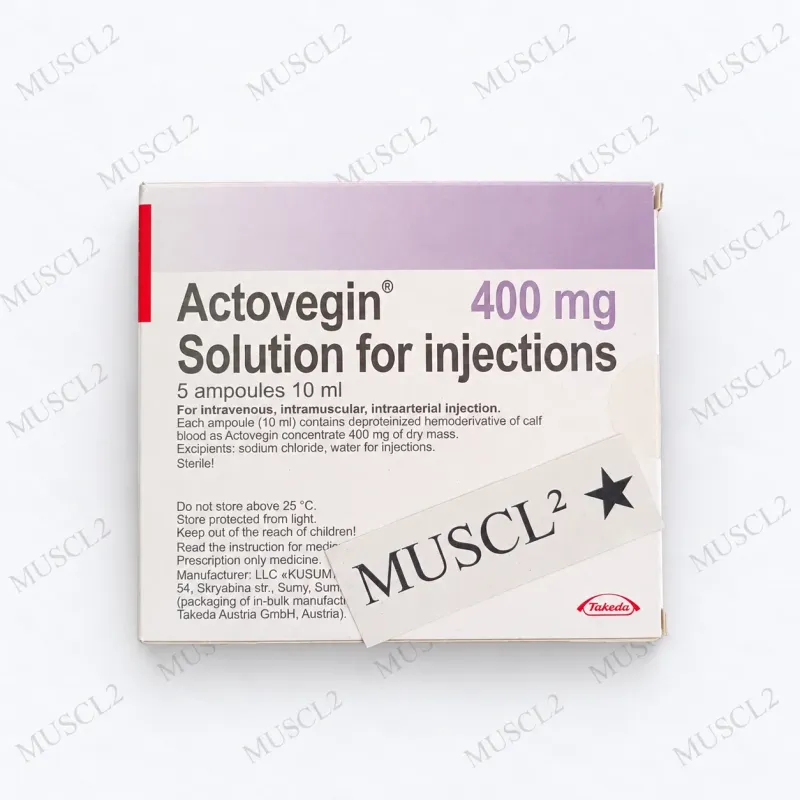
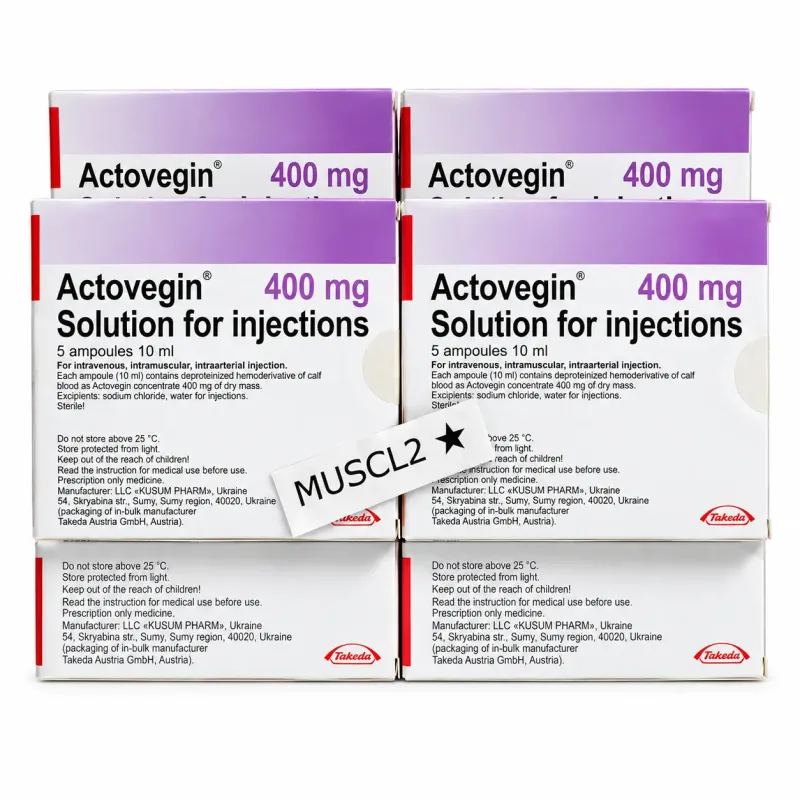
Actovegin 400 mg/10 ml. (5 ampoules)
- Manufacturer: Takeda (Japan)
- Product Code: acto400
- Availability: In Stock
68.00€
- Delivery within EU (3-5 days)
Actovegin 400 mg / 10 ml – 5 Ampoules
Actovegin 400 mg / 10 ml is an injectable medicinal preparation based on a deproteinized hemoderivative obtained from calf blood. One 10 ml ampoule provides 400 mg of the active substance on a dry-weight basis, giving the solution a concentration of 40 mg/ml. This presentation contains 5 individual ampoules.
Beyond its established medical applications in countries where Actovegin is approved, the preparation has been the subject of scientific interest in exercise physiology and sports medicine. Researchers have examined how Actovegin interacts with mitochondrial respiration, glucose utilization and energy-producing pathways in skeletal muscle. These findings have generated discussion around physical performance and recovery.
Actovegin 400 mg / 10 ml Product Details
Why Actovegin Attracts Interest in Sports Science
Actovegin is unusual in sports pharmacology because research interest is not centered on a conventional stimulant mechanism. Instead, scientists have investigated its possible influence on cellular processes involved in aerobic metabolism and energy production.
Several areas have received particular attention:
- Oxidative phosphorylation inside mitochondria
- Mitochondrial respiratory capacity in skeletal muscle
- Glucose uptake and cellular glucose metabolism
- Oxygen-dependent energy production
- ATP-generating metabolic pathways
- Muscle response to intense physical stress
- Recovery following muscular injury or heavy exercise
These mechanisms are relevant to exercise physiology because working skeletal muscle depends heavily on efficient oxygen utilization and mitochondrial ATP production.
Research on Skeletal Muscle Mitochondria
A frequently cited study published in the European Journal of Sport Science investigated Actovegin directly in permeabilized human skeletal muscle fibers. The researchers measured mitochondrial respiration after exposing the muscle samples to different concentrations of Actovegin.
The experiment showed a concentration-dependent increase in oxidative phosphorylation capacity. Effects were observed in respiration linked to mitochondrial Complex I as well as pathways involving Complex I and Complex II.
This research is important because it demonstrates that Actovegin can modify mitochondrial oxidative function in human muscle tissue under laboratory conditions. However, the study examined isolated muscle fibers rather than athletes receiving the medicine.
Human Exercise Performance: What Has Been Found?
The results become less convincing when Actovegin is tested using actual exercise performance rather than isolated muscle tissue.
In a placebo-controlled study involving physically active men, investigators administered intravenous Actovegin before exhaustive upper-body exercise and evaluated variables including peak power output, oxygen consumption, lactate, blood glucose and several measures of physiological efficiency.
Actovegin did not produce a meaningful improvement in peak exercise capacity compared with placebo.
2026 Study on Actovegin and High-Intensity Exercise
More recent research has renewed scientific interest in Actovegin. A study published in 2026 examined the preparation together with high-intensity training and measured both exercise capacity and mitochondrial respiration.
The experiment involved mice divided into control, Actovegin, training and combined Actovegin-plus-training groups. Researchers found increased mitochondrial respiratory capacity in several intervention groups. The animals receiving both high-intensity training and Actovegin also showed a greater improvement in exercise capacity than animals undergoing training alone.
Actovegin in Muscle Injury and Recovery Research
Another reason Actovegin is encountered in sports-medicine literature is its historical use in the management of muscle injuries. The preparation has been included in treatment protocols for muscular strains and other soft-tissue problems, particularly in professional football.
Some published observations have reported shorter rehabilitation periods or an earlier return to training.
Energy Metabolism, Oxygen and Glucose
The proposed metabolic activity of Actovegin is another major area of research. Skeletal muscle requires a continuous supply of ATP during exercise, and mitochondrial oxidation of metabolic substrates represents a central source of this energy during aerobic work.
Experimental studies have examined whether components of Actovegin can influence oxygen-dependent metabolism and glucose-related cellular pathways. This has led researchers to describe Actovegin primarily in terms of metabolic modulation rather than stimulation of the central nervous system.
This distinction is relevant when discussing Actovegin in a sports context. Its research profile is fundamentally different from that of classic stimulants. The scientific question is whether measurable changes in cellular metabolism can ultimately produce clinically or athletically meaningful outcomes in humans.
What Is in an Actovegin 400 mg Ampoule?
According to the Austrian product information, each 10 ml ampoule of Actovegin 400 mg contains:
- 400 mg deproteinized hemoderivative of calf blood, calculated as dry substance
- Water for injection
- Diluted hydrochloric acid for adjustment of pH
The injectable solution has a clear, yellowish appearance. The 400 mg / 10 ml presentation provides the same 40 mg/ml concentration commonly associated with Actovegin injectable formulations, but in a larger 10 ml ampoule.
Administration of Actovegin 400 mg / 10 ml
Actovegin 400 mg / 10 ml is supplied as a solution for intravenous use. The Austrian Summary of Product Characteristics also describes its use as an additive to compatible infusion solutions.
As this is an injectable medicinal product, administration should be carried out by a qualified healthcare professional in accordance with the approved prescribing information and medical requirements applicable in the country where the product is used.
What the Current Evidence Actually Shows
Actovegin occupies an interesting position in exercise-related research. Laboratory experiments provide evidence that it can alter mitochondrial respiratory activity in skeletal muscle, while recent animal research has produced additional findings involving exercise capacity and high-intensity training.
Scientific References
- Søndergård SD, Dela F, Helge JW, Larsen S. Actovegin, a non-prohibited drug increases oxidative capacity in human skeletal muscle. European Journal of Sport Science. 2016;16(7):801-807.
PubMed: PMID 26744809 → - Lee P, Nokes L, Smith PM. No effect of intravenous Actovegin on peak aerobic capacity. International Journal of Sports Medicine. 2012;33(4):305-309.
PubMed: PMID 22318562 → - Hassø RK, Lindtofte S, Kosik B, Bergdahl A, Larsen S. The effect of 14 days Actovegin administration with or without high intensity training on exercise capacity and skeletal muscle mitochondrial respiration. European Journal of Applied Physiology. 2026;126:3129-3138.
PubMed: PMID 41553522 →
FAQ
What is Actovegin 400 mg / 10 ml?
It is an injectable formulation containing 400 mg of deproteinized calf blood hemoderivative in each 10 ml ampoule. The resulting concentration is 40 mg/ml.
Why do sports researchers study Actovegin?
Scientific interest is mainly related to mitochondrial respiration, cellular energy metabolism, oxygen utilization and glucose-related metabolic processes. These mechanisms are relevant to skeletal muscle function during exercise.
Can Actovegin improve athletic performance?
Laboratory studies have demonstrated effects on mitochondrial function.
What did the 2026 Actovegin study find?
The 2026 study found changes in skeletal muscle mitochondrial respiratory capacity and reported improved exercise performance when Actovegin was combined with high-intensity training.
Is Actovegin 400 mg different from Actovegin 200 mg?
The main difference between these ampoule presentations is the total volume and amount of active substance per ampoule. Actovegin 400 mg contains 400 mg in 10 ml, while a 200 mg / 5 ml ampoule contains 200 mg in 5 ml. Both correspond to a concentration of 40 mg/ml.
Has Actovegin been researched for muscle injuries?
Yes. Actovegin has been discussed in sports-medicine literature and has appeared in treatment protocols involving muscular injuries. Some publications have reported encouraging recovery outcomes.
How does Actovegin differ from a stimulant?
Actovegin is not researched primarily for central nervous system stimulation. Its scientific literature focuses more on metabolic pathways, mitochondrial activity and cellular substrate utilization.
How many ampoules are included in this presentation?
This Actovegin 400 mg / 10 ml presentation contains 5 ampoules, with 400 mg of active substance in each 10 ml ampoule.
Delivery within the EU
We deliver to all countries within the European Union: